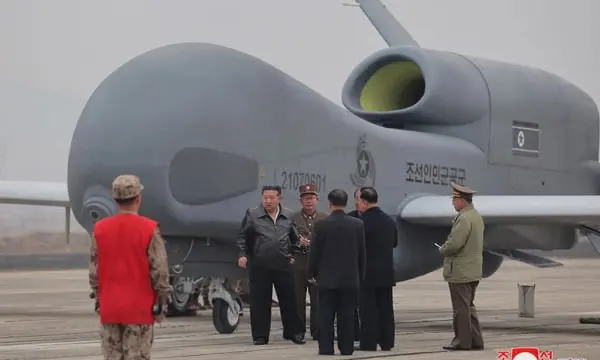
Long-range drones—unmanned aerial vehicles with ranges far
The ongoing aerial standoff between North and South Korea threatens to radically reshape the strategic balance on the peninsula. Pyongyang's ability to conceal, disperse, and operate drones, missiles, and nuclear weapons is advancing much faster than Seoul's capacity to intercept and destroy them.
Breaking news
 Montenegro, Albania Seek NATO Help to Counter Russian Disinformation
 Ronna McDaniel Weighs In on GOP's Path Forward
 Market Sentiment Shifts as S&P 500 Snaps Three-Day Losing Streak
 Voters Demand Stronger Congressional Oversight of Presidential Power
This new dynamic fits into a complex geopolitical framework. Both states have closely monitored recent conflicts in Ukraine and Iran. These wars reflect the exact warfare scenarios each side considers plausible for its own territory.
Recent exchanges of long-range drone and missile strikes bear a striking resemblance to this mutual vision of deep-strike warfare. Consequently, both governments have begun developing low-cost, long-range attack drones. Some of these systems are scheduled to become operational in the near future.
Historically, long-range artillery, ballistic missiles, and nuclear arms dictated how each side perceived the military balance. Now, however, offensive drones are entering the equation. These systems will only amplify existing gaps in South Korea's surveillance sector regarding the northern territories.
The problem becomes acute as Pyongyang expands its missile and nuclear arsenals alongside diverse launch platforms. With cheap attack drones entering the battlefield, the offensive potential will easily surpass Seoul's ability to neutralize the threat.
This trend directly contradicts the ambitious timeline set by the Lee administration to regain wartime operational control from the United States. South Korean forces must acquire advanced capabilities to meet the qualitative standards previously established by the two allies.
Long-range drones—unmanned aerial vehicles with ranges far exceeding the traditional front lines along the armistice line—have featured in the inter-Korean military competition for nearly two decades. The first known operational use occurred in 2010. During the bombardment of Yeonpyeong Island, a northern reconnaissance drone was spotted overhead.
Since then, periodic drone incursions have become a staple of low-intensity friction between the two nations. In 2014, the South Korean military recovered the wreckage of three northern drones less than 50 miles from the border.
In December 2022, five drones from the north flew over the capital city of Seoul. They even passed over the presidential office before returning safely to the north.
In response, then-President Yoon Suk-yeol suggested that South Korean forces should conduct reciprocal drone incursions into northern territory. By October 2024, the North claimed that South Korean drones had flown over Pyongyang. Seoul officially denied the claim, but visual evidence closely matched South Korean reconnaissance systems currently under development, according to analysis of images published by northern state media.
Over the years, North Korea has imported
Until now, these largely symbolic aerial incursions involved primitive platforms. They utilized small, fixed-wing airframes, turbo-prop engines, and unarmed designs, alongside unpowered balloons.
There is no concrete evidence that either side has yet deployed armed drones in cross-border operations. Nevertheless, the drones currently seen in action represent only a small fraction of a much broader inventory. Both sides possess systems featuring superior autonomy and advanced capabilities.
Over the years, North Korea has imported Chinese and Soviet-origin drones. Since the 1980s, the regime has also developed domestic models dedicated to reconnaissance missions.
In 2023, the northern regime showcased a high-altitude, long-endurance (HALE) reconnaissance drone. It also displayed a medium-altitude, long-endurance (MALE) multi-mission drone.
Both platforms differ qualitatively from older unmanned aircraft. The latter model, for example, can launch a missile, though current stockpiles remain limited.
For South Korea, initial development efforts stalled at the end of the Cold War. However, programs resumed in the 1990s with a primary focus on tactical surveillance drones to support Army ground operations.
Interest in long-range systems emerged toward the late 2000s. The Agency for Defense Development (ADD) began creating a domestic MALE model known as the KUS-FS. Meanwhile, the Republic of Korea Air Force acquired Global Hawk drones directly from the United States.
By 2020, four Global Hawks had been successfully delivered. The domestic KUS-FS is scheduled to enter active military service in 2027.
Ultimately, the ongoing wars in Ukraine and Iran have catalyzed intense interest across both Koreas. Both nations now focus heavily on mass-produced, cheap, armed, and long-range drones, while simultaneously continuing investments in massive, highly sophisticated unmanned systems.
