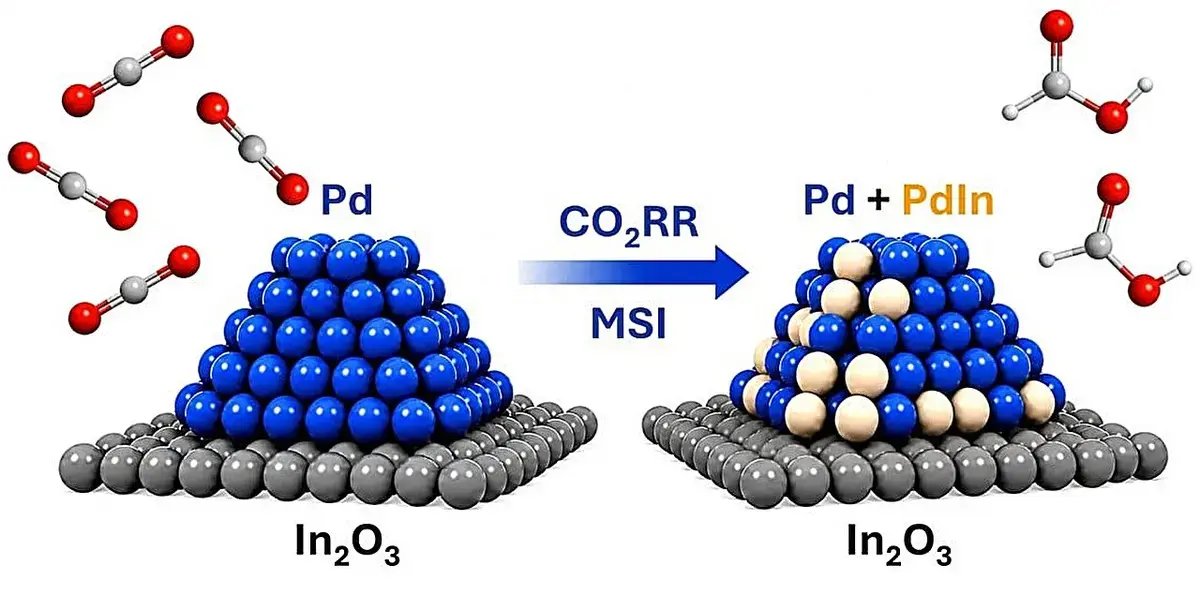
Catalyst Interface Restructuring
Researchers at National Taiwan University have made a breakthrough in converting CO₂ into formic acid using a dynamic catalyst interface.
Breaking news
 Deadly Glacier and Rock Collapse in Nepal Linked to Climate Warming
 US Congress Passes Sweeping Sanctions Against Russia
 Speaker Johnson Ends House Session Early to Halt Impeachment Effort
 The High-Stakes Fight for Senate Majority Control
The team discovered that by using a specific catalyst structure, they could improve the efficiency of the electroreduction process, which converts CO₂ into valuable chemicals using renewable energy.
The researchers found that the metal support interaction (MSI) drove the restructuring of Pd/In2O3 catalysts into Pd–In alloy sites during CO₂ electroreduction. This restructuring led to a significant improvement in the catalyst's performance and stability.
Can Catalyst Design be Optimized?
The team observed that the Pd–In alloy sites exhibited a higher activity and selectivity towards formic acid production. The researchers attributed this to the unique electronic properties of the alloy sites, which facilitated the adsorption and reduction of CO₂.
To further improve the catalyst's performance, the researchers investigated the effects of different catalyst compositions and structures. They found that by optimizing the Pd/In2O3 ratio and the catalyst's surface morphology, they could enhance the catalyst's activity and stability.
The study's findings have significant implications for the development of efficient CO₂ conversion technologies. By designing dynamic catalyst interfaces, researchers can create more effective catalysts for converting CO₂ into valuable chemicals.
Frequently Asked Questions
Q: What is the significance of converting CO₂ into formic acid? A: Formic acid is a valuable chemical used in various industries, and converting CO₂ into formic acid can help reduce greenhouse gas emissions.
Q: How does the dynamic catalyst interface improve CO₂ conversion? A: The restructuring of the catalyst into Pd–In alloy sites enhances the catalyst's activity and selectivity towards formic acid production.
Q: What are the potential applications of this technology? A: The development of efficient CO₂ conversion technologies can help mitigate climate change by reducing CO₂ emissions and producing valuable chemicals.