How Microscopic Twisting Unlocks New Views
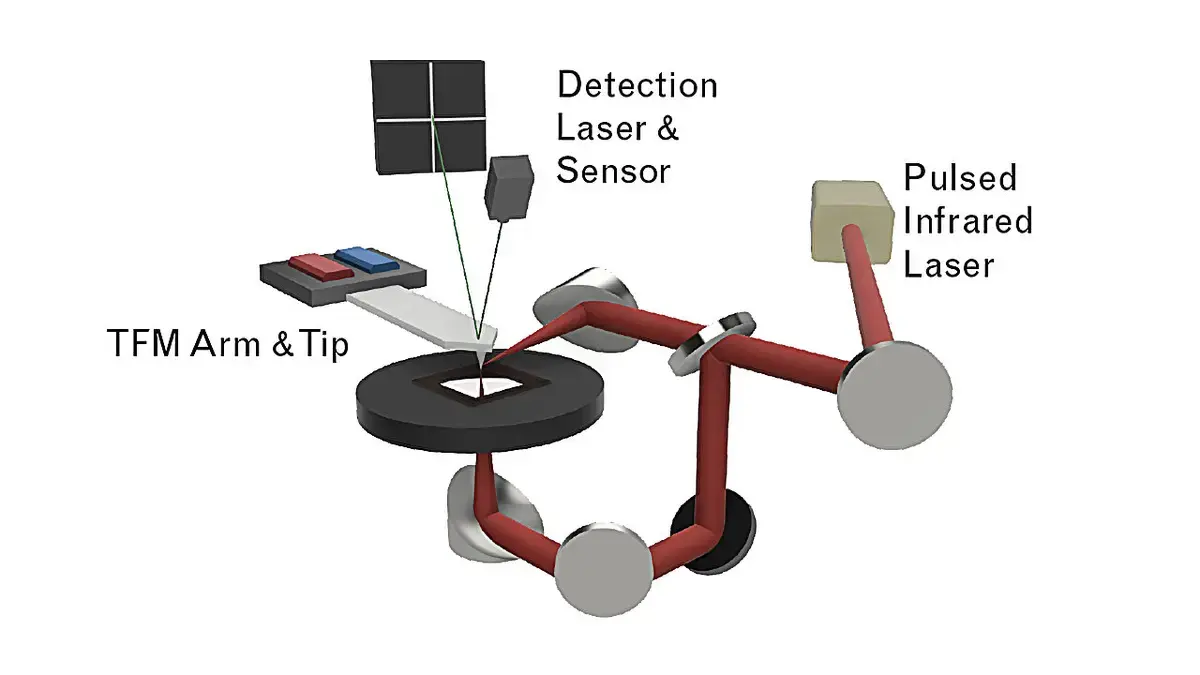
Scientists have developed a groundbreaking method to examine two-dimensional materials with unprecedented clarity. Researchers at the University of Maryland achieved this by rapidly oscillating a tiny probe. This innovative approach offers a much higher resolution view of these ultra-thin substances.
Breaking news
 Deadly Glacier and Rock Collapse in Nepal Linked to Climate Warming
 US Congress Passes Sweeping Sanctions Against Russia
 Speaker Johnson Ends House Session Early to Halt Impeachment Effort
 The High-Stakes Fight for Senate Majority Control
The technique involves twisting a microscopic tip back and forth at high speeds. This motion allows the tip to interact with the material in a novel way. It captures details previously invisible with standard imaging methods.
The key to this advancement lies in the precise control of the probe's movement. By twisting the tip, scientists can effectively feelthe surface of the 2D material at an atomic scale. This creates a more detailed topographical map. It helps in understanding the material's structural properties.
Why is a High-Resolution View Important?
This method overcomes limitations of traditional microscopy. Those often struggle to resolve the fine features of single-atom-thick layers. The rapid twisting motion provides a dynamic interaction that enhances signal collection. This leads to a sharper image.
Understanding 2D materials at an atomic level is crucial for their development. These materials, like graphene, have unique electronic and mechanical properties. They hold great promise for future technologies. Better imaging allows scientists to identify defects or irregularities. These can significantly impact a material's performance.
For instance, in electronics, even small imperfections can alter conductivity. In quantum computing, precise atomic arrangements are vital. This new technique could accelerate the design of advanced devices. It offers a powerful tool for material characterization.
The ability to see these materials with such detail will likely lead to new discoveries. It could unlock their full potential across various fields. This includes next-generation electronics, sensors, and energy storage. The research marks a significant step forward in nanotechnology.
Frequently Asked Questions
What are 2D materials? 2D materials are substances consisting of a single layer of atoms. Graphene is a well-known example. They exhibit unique properties due to their extreme thinness.
How does this new technique differ from traditional microscopy? Traditional microscopy often uses static probes or simpler scanning patterns. This new method employs a rapid, twisting motion of the probe. This dynamic interaction provides much finer detail and higher resolution.
What are the potential applications of this research? This technique could advance the development of new electronics, more efficient sensors, and improved energy storage solutions. It helps scientists better understand and manipulate materials at the atomic scale.