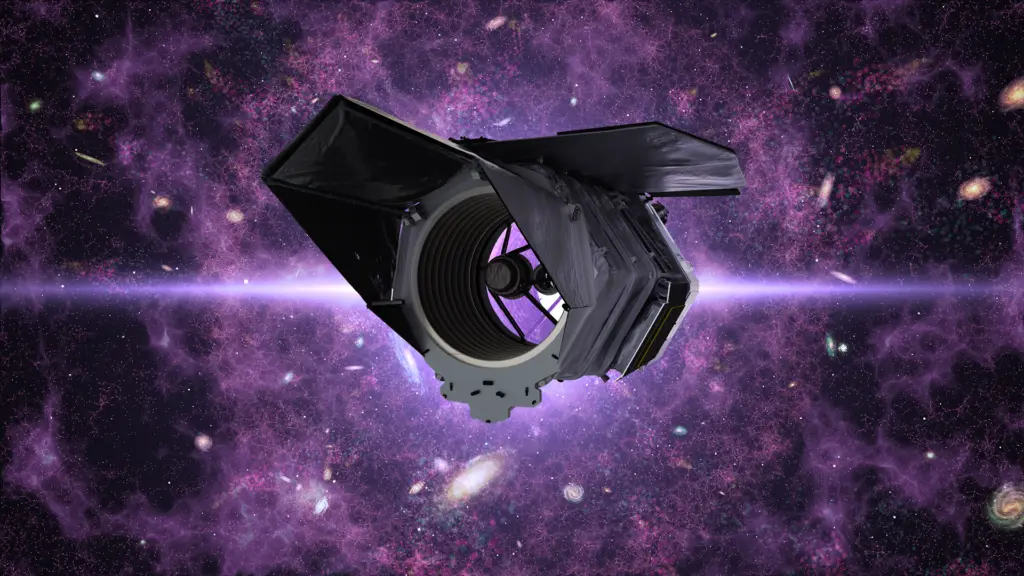
How Roman Will Hunt for Dark Energy
The Nancy Grace Roman Space Telescope is set for launch in August 2026, marking a major step in NASA’s mission to explore dark energy and exoplanets. Developed over years of planning, the observatory will operate from a stable orbit beyond the Moon, scanning wide swaths of the sky with unprecedented precision. Its primary goal is to uncover the nature of dark energy by mapping the distribution of galaxies across cosmic time.
Breaking news
 Deadly Glacier and Rock Collapse in Nepal Linked to Climate Warming
 US Congress Passes Sweeping Sanctions Against Russia
 Speaker Johnson Ends House Session Early to Halt Impeachment Effort
 The High-Stakes Fight for Senate Majority Control
The telescope features a 2.4-meter mirror, identical in size to Hubble’s, but with a field of view 100 times wider, enabling rapid surveys of the universe. Equipped with two main instruments—the Wide Field Instrument and the Coronagraph Instrument—it will capture high-resolution images and spectra to study galaxy formation, dark matter, and distant worlds. Unlike Hubble, which observes narrow patches deeply, Roman is designed for broad, efficient sky coverage, allowing scientists to detect rare cosmic events and statistical patterns across vast regions.
What Could Roman Discover About Alien Worlds
By measuring the shapes and distances of millions of galaxies, Roman will track how dark energy has influenced the expansion of the universe over billions of years. Scientists will use weak gravitational lensing—subtle distortions in galaxy shapes caused by intervening mass—to map dark matter structures. Combined with data on supernovae and galaxy clustering, these measurements aim to test whether dark energy is constant or evolves over time, addressing one of cosmology’s biggest mysteries.
Using its coronagraph, Roman will block starlight to directly image large exoplanets orbiting nearby stars, a feat difficult for current telescopes. This technology demonstrator could pave the way for future missions seeking Earth-like planets. Additionally, the telescope’s microlensing survey will detect thousands of distant exoplanets by observing how their gravity bends light from background stars, revealing planets too far or dim for other methods to find.
What makes the Nancy Grace Roman Space Telescope different from Hubble? Roman has a much wider field of view than Hubble, allowing it to survey large areas of the sky quickly, while Hubble excels at deep, detailed observations of small regions.
Frequently Asked Questions
Will Roman be able to find Earth-like planets? Roman’s coronagraph is a technology test for imaging large exoplanets, not Earth twins, but its microlensing survey could detect cold, distant planets similar in mass to Earth.
When will Roman begin sending data back to Earth? After launch in August 2026, the telescope will undergo several months of calibration and testing before starting its primary science mission, expected to begin in early 2027.