How Did AI Contribute to the Mathematical Process?
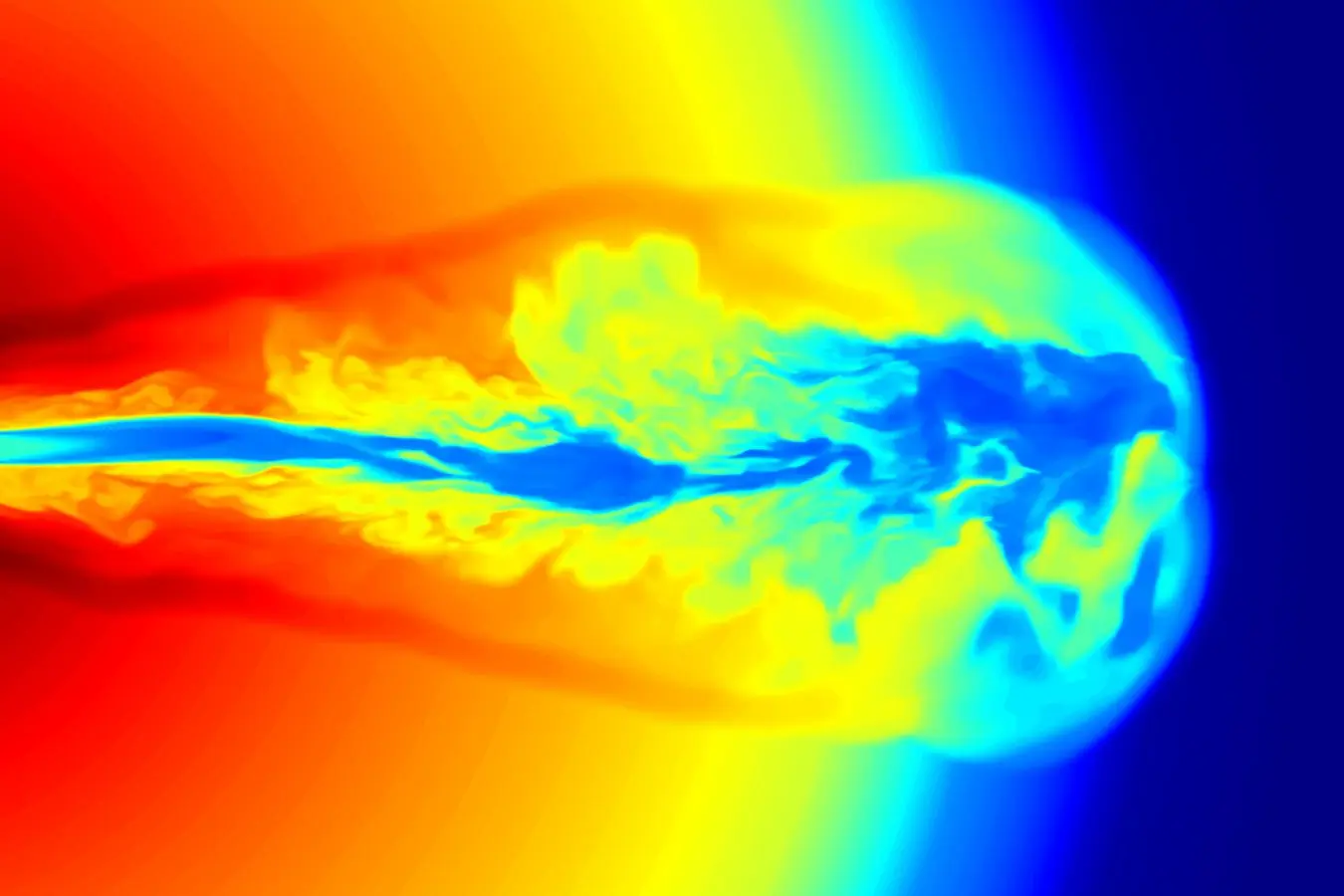
Two mathematicians have made significant advances on the Navier-Stokes equations with substantial assistance from artificial intelligence, producing three key findings that bring researchers closer to solving one of mathematics' most famous unsolved problems. The breakthrough emerged from a collaborative effort where human insight was augmented by AI-driven pattern recognition and computational exploration, focusing on the behavior of fluid flow under extreme conditions. This development represents a notable step in addressing the Clay Mathematics Institute's Millennium Prize problem, which has resisted solution for over two decades despite intense global effort.
Breaking news
 Deadly Glacier and Rock Collapse in Nepal Linked to Climate Warming
 US Congress Passes Sweeping Sanctions Against Russia
 Speaker Johnson Ends House Session Early to Halt Impeachment Effort
 The High-Stakes Fight for Senate Majority Control
The Navier-Stokes equations govern the motion of liquids and gases, forming the foundation for understanding phenomena ranging from weather patterns to aircraft design. However, proving whether solutions always remain smooth and physically reasonable—or can develop infinite singularities—has remained elusive. The researchers employed AI to analyze vast datasets of numerical simulations, identifying recurring structures in potential blow-up scenarios that might otherwise have gone unnoticed. These patterns informed new mathematical conjectures, which the human collaborators then rigorously tested and refined using traditional analytical methods. One finding suggests a previously unrecognized constraint on how vorticity can concentrate in three-dimensional flow, while another establishes a link between certain symmetries and stability criteria. The third result provides improved bounds on energy dissipation in approximate solutions, narrowing the gap between computational evidence and theoretical proof.
Artificial intelligence served as a discovery tool rather than a proof generator, sifting through terabytes of simulation data to detect subtle geometric and topological features in near-singularity states. The AI was trained on known solutions and perturbed configurations, learning to flag anomalies associated with rapid vorticity growth. Mathematicians then interpreted these signals, formulating hypotheses about underlying mechanisms. This iterative loop—where AI highlights unusual behavior and humans provide explanatory frameworks—proved essential in identifying the three advances. Crucially, the AI did not replace human ## What Remains to Be Proven for a Complete Solution?
Despite these advances, a full resolution of the Navier-Stokes problem requires demonstrating either that smooth solutions exist for all time or that finite-time blow-up can occur under physically admissible conditions. The current results constrain possible scenarios but do not yet rule out singularities nor confirm global regularity. Experts note that overcoming the final hurdles will likely demand new mathematical concepts beyond incremental refinements of existing techniques. The interplay between geometric measure theory, harmonic analysis, and nonlinear PDEs may need to deepen, possibly inspired by further AI-assisted exploration of high-dimensional solution spaces.
Frequently Asked Questions
What is the Navier-Stokes Millennium Problem? It is one of seven Clay Mathematics Institute problems offering a $1 million prize for proving whether solutions to the Navier-Stokes equations always remain smooth or can develop singularities in finite time.
Why is AI useful in pure mathematics research? AI can process vast amounts of numerical or symbolic data to detect patterns, guide conjecture formation, and explore complex parameter spaces that are infeasible for manual analysis, acting as a force multiplier for human intuition.
Has any progress been made on other Millennium Problems using AI? While AI has assisted in areas like knot theory and computational number theory, no Millennium Problem has yet been solved with AI involvement; the Navier-Stokes work represents one of the most promising instances of human-AI collaboration in pure mathematics to date.