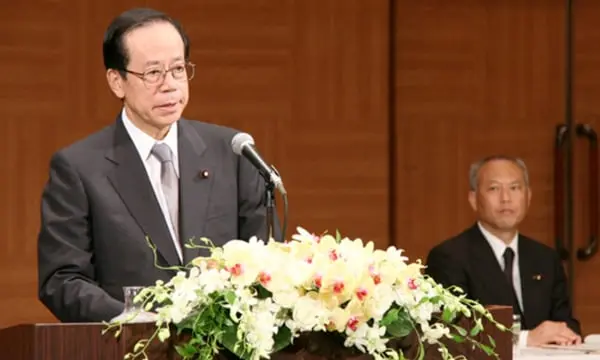
Fukuda Yasuo’s Diplomatic Legacy: A Life Dedicated
Yasuo Fukuda, former Prime Minister of Japan, passed away in Tokyo on October 22. He was 90. His death marks the end of a remarkable political career. His father, Takeo Fukuda, and he became the first father-son duo to serve as prime minister in Japanese history.
Breaking news
 Ronna McDaniel Weighs In on GOP's Path Forward
 Market Sentiment Shifts as S&P 500 Snaps Three-Day Losing Streak
 Voters Demand Stronger Congressional Oversight of Presidential Power
 Pelosi Looks Back, Sees Democratic Triumph Ahead
Yasuo Fukuda took office on September 26, 2007. He was 71 years old. He assumed leadership after Shinzo Abe’s sudden resignation. From the start, he faced major challenges. This was the era of the „obstructed Diet.” The Liberal Democratic Party had lost its majority in the House of Councillors following the July 2007 elections.
His administration’s immediate priority was extending the Special Act on Anti-Terrorism Measures. This law allowed the Self-Defense Forces to continue oil supply missions in the Indian Ocean. The missions were based on a UN Security Council resolution. However, opposition parties resisted this extension. Because the Democratic Party of Japan controlled the upper house, the bill was blocked there. The Fukuda government had to pass it through the lower house. This required a two-thirds majority.
Fukuda believed extending the Indian Ocean mission was essential for the Japan-US military alliance. His foreign policy emphasized the US relationship. He also prioritized peace and prosperity in the Asia-Pacific region. This aligned with the „Fukuda Doctrine,” promulgated by his father in 1977 in Manila.
During Junichiro Koizumi’s government, Fukuda served as Cabinet Secretary-General. He warned Koizumi about the negative impact of official visits to the Yasukuni Shrine. The shrine commemorates Class A war criminals. Fukuda reiterated that Koizumi should avoid visiting the shrine during his term. This was to protect relations with neighboring countries, especially China.
Fukuda’s diplomatic philosophy was clearly articulated in a speech at the 14th International Conference on the Future of Asia. This event took place in Tokyo on May 22, 2008. In this speech, he emphasized the Fukuda Doctrine. He announced „five commitments” for a „Future Asia that acts together.”
Fukuda believed extending the Indian Ocean mission
First, supporting ASEAN efforts to achieve a community. Second, strengthening the Japan-US military alliance as a „public good” in the Asia-Pacific. Third, promoting diplomacy for disaster management cooperation. Fourth, facilitating youth exchanges in the Asia-Pacific. Fifth, combating climate change by establishing a low-carbon society. It is remarkable that these five commitments valued a variety of international cooperation efforts. These included responses to natural disasters and environmental issues.
On September 1, 2008, Fukuda announced his resignation from the leadership position. Four years later, on September 26, 2012, he announced he would not run in the next general election. When Prime Minister Yoshihiko Noda dissolved the lower house on November 16, 2012, Fukuda retired as a member of the House of Representatives. His constituency was taken over by his son, Tatsuo Fukuda. Later, Fukuda Yasuo was appointed a special envoy by Prime Minister Abe. Along with Prince Naruhito, he attended the funeral of former South African President Nelson Mandela on December 9, 2013.
His philosophy on peace is evident in his policy speeches to the Diet. In his general policy speech on October 1, 2007, Fukuda used the word „peace” four times. He declared his government would promote diplomacy based on the Japan-US alliance. He also emphasized international cooperation to contribute to world peace. He explained that it was important for the Self-Defense Forces to continue UN-authorized anti-terrorism activities in the Indian Ocean. Fukuda also mentioned the importance of peace in Asia. He highlighted the need for denuclearization of the Korean Peninsula, which influenced Japan’s peace and defense.
In his administrative speech on January 18, 2008, Fukuda used the word „peace” ten times. He argued Japan should become a „cooperative state for peace.” He believed Japan could contribute to solving global problems. Specifically, he stated Japan needed to contribute to international cooperation for post-war peace. This included activities in the Indian Ocean, Afghanistan, and Iraq. He also mentioned the need to strengthen diplomatic efforts for non-proliferation of weapons of mass destruction. He also emphasized fighting terrorism. Furthermore, Fukuda expressed his view on world peace. He argued Japan’s international cooperation for peace should not be limited to security. It should include other areas like global warming, poverty, and global health issues.
Significantly, his philosophy on peace is also reflected in his speech at the Hiroshima Peace Memorial Ceremony on August 6, 2008. In this speech, Fukuda used the word „peace” eleven times. He committed that Japan, as a „nation that cultivates peace,” should „firmly uphold the Non-Nuclear Principles.” He aimed to lead the international community toward total elimination of nuclear weapons and the realization of permanent peace. He also supported the establishment of the International Commission on Nuclear Non-Proliferation and Disarmament (ICNND). This commission was proposed that same year by Australian Prime Minister Kevin Rudd.