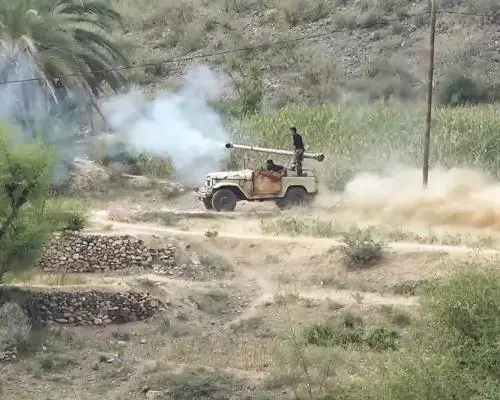
The Houthis, who receive military and financial backing from Tehran
Renewed clashes between Iran-aligned Houthi rebels and Saudi-backed Yemeni government forces have killed and wounded approximately 1,000 people, displacing tens of thousands across western Yemen. The fighting, concentrated along the Red Sea coastline, marks the most intense confrontation between the two sides in years, with both parties exchanging aerial bombardments, missile strikes, and drone attacks. The escalation threatens to destabilize a region already strained by years of humanitarian crisis and regional power struggles. The Houthis have launched a renewed offensive to seize control of strategic coastal areas currently held by government forces, aiming to strengthen their grip on vital maritime routes and trade corridors. Saudi Arabia, leading a coalition supporting Yemen’s internationally recognized government, has responded with intensified air campaigns targeting Houthi positions. Analysts note the timing coincides with broader regional tensions, particularly the indirect confrontation between the United States and Iran, where Yemen has become a proxy battleground.
Breaking news
 Deadly Glacier and Rock Collapse in Nepal Linked to Climate Warming
 US Congress Passes Sweeping Sanctions Against Russia
 Speaker Johnson Ends House Session Early to Halt Impeachment Effort
 The High-Stakes Fight for Senate Majority Control
The Houthis, who receive military and financial backing from Tehran, have increasingly framed their actions as resistance against foreign intervention, while Riyadh views the group as an Iranian proxy threatening regional stability. How Does the Red Sea Coastline Factor into the Conflict? Control of Yemen’s Red Sea coastline is critical due to its proximity to the Bab el-Mandeb Strait, a narrow waterway through which nearly 10% of global trade passes, including oil shipments bound for Europe and Asia. The Houthis have previously used coastal launch sites to fire missiles and drones at vessels in the strait, prompting international naval patrols. Gaining full control of this stretch would allow them to threaten shipping lanes more effectively and leverage their position in negotiations.
Government forces, supported by Saudi airstrikes and naval blockades, are
Government forces, supported by Saudi airstrikes and naval blockades, are determined to prevent this outcome, fearing it would embolden Houthi capabilities and expand Iranian influence along Africa’s eastern shore. What Are the Humanitarian Consequences of This Escalation? The renewed violence has worsened an already dire humanitarian situation, with hospitals overwhelmed by casualties and aid organizations struggling to reach displaced populations. Over 80% of Yemen’s population already relies on some form of assistance, and the latest fighting has disrupted food distribution, water supplies, and medical services in affected zones. The United Nations has warned that continued hostilities could push parts of the country into famine conditions, particularly as rainy seasons approach and disease risks rise.
Despite repeated calls for ceasefires, neither side shows signs of backing down, leaving civilians caught in a cycle of violence with limited access to safety or basic needs. Frequently Asked Questions Why is Saudi Arabia involved in Yemen’s conflict? Saudi Arabia leads a military coalition supporting Yemen’s government to counter what it sees as Iranian influence through the Houthis, whom it views as a national security threat due to their cross-border attacks. How does the U. S.-Iran tension affect Yemen? The United States supports Saudi Arabia’s coalition with intelligence and logistics, while Iran backs the Houthis, making Yemen a focal point for their indirect rivalry, though direct combat between U. S. and Iranian forces remains avoided. Can the Red Sea shipping route be disrupted by this fighting?
Yes, Houthi control of coastal areas increases the risk of missile or drone attacks on commercial ships, potentially forcing rerouting and raising global shipping costs, though international naval forces continue to monitor the strait closely.