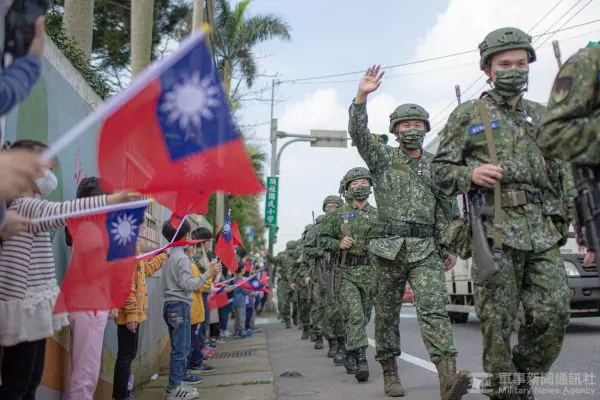
From Conscription to Professionalism: The Human Capital Shift
The conversation took place in late September 2024 between Mercy Kuo of The Diplomat and Dr. Eric Setzekorn, a historian specializing in East Asian security and author of the forthcoming book On the Brink: A Military History of Taiwan . Setzekorn, who has taught at several universities and consulted for defense ministries, offered a sweeping review of Taiwan’s armed forces from the 1940s to the present, emphasizing recent reforms and strategic challenges.
Breaking news
 Ronna McDaniel Weighs In on GOP's Path Forward
 Market Sentiment Shifts as S&P 500 Snaps Three-Day Losing Streak
 Voters Demand Stronger Congressional Oversight of Presidential Power
 Pelosi Looks Back, Sees Democratic Triumph Ahead
Setzekorn traced the island’s military roots to the chaotic aftermath of World War II, when the Kuomintang inherited Japanese equipment and doctrine. He explained that the early force was built for a conventional, large‑scale invasion by the People’s Republic of China, relying on outdated artillery and a conscript army. Over the decades, Taiwan shifted toward a more mobile, technology‑driven posture, driven by dwindling manpower, U. S. arms sales, and the need to counter sophisticated Chinese missile systems. The historian highlighted three pivotal reforms: the 1992 „All‑Volunteer” transition, the 2005 acquisition of indigenous missile‑defence platforms, and the 2022 launch of a cyber‑warfare command.
The 1992 decision to end mandatory military service marked a cultural and operational turning point. „We moved from a 2‑million‑strong conscript army to a lean professional force of about 150,000,” Setzekorn noted. This reduction forced the military to prioritize quality over quantity, investing heavily in advanced training and joint exercises with U. S. forces. The shift also spurred the development of the „Taiwanese Model” of reserve integration, where former conscripts receive periodic refresher drills while maintaining civilian careers.
Can Taiwan’s New Tech Defenses Counter a Mainland Assault?
Setzekorn pointed to the 2020 „Smart Soldier” program, which equips infantry with networked helmets, night‑vision devices, and real‑time data links. „These tools compress the decision‑making cycle, allowing a small unit to punch above its weight against a numerically superior adversary,” he said. The program has been credited with improving morale and attracting high‑skill volunteers, a crucial factor as Taiwan’s birth rate continues to decline.
The historian argued that Taiwan’s recent focus on asymmetric warfare is its most promising deterrent. Indigenous missile‑defence systems, such as the Hsiung Feng 3, now cover key ports and airfields, while the 2022 cyber‑command can disrupt PLA command‑and‑control networks. „We are no longer trying to match China ship‑for‑ship or plane‑for‑plane,” Setzekorn explained. „Instead, we aim to make any invasion costly and chaotic.”
Nevertheless, Setzekorn cautioned that technology alone cannot guarantee security. He warned that China’s anti‑access/area‑denial (A2/AD) capabilities, including long‑range ballistic missiles and advanced drones, continue to erode Taiwan’s defensive depth. The historian emphasized the need for continued U. S. security assistance, particularly in next‑generation air‑defence radar and integrated air‑space management.
Looking ahead, Setzekorn sees Taiwan’s military evolving into a „network‑centric, multi‑domain force” that blends land, sea, air, cyber, and space assets. He predicts that by 2035 the island will field a fleet of domestically built stealth corvettes, a robust missile‑defence shield, and a fully operational cyber‑reserve capable of rapid mobilization. The historian concluded that while the balance of power remains tilted toward Beijing, Taiwan’s adaptive reforms have narrowed the gap and increased the political cost of any aggressive move.
Frequently Asked Questions
What is the current size of Taiwan’s active‑duty military? Around 150,000 personnel serve full‑time, supplemented by a reserve component of roughly 1.5 million who undergo periodic training.
How does Taiwan acquire its most advanced weapons? Primarily through U. S. Foreign Military Sales, supplemented by an expanding domestic defense industry that produces missiles, drones, and naval vessels.
What role does cyber‑warfare play in Taiwan’s defense strategy? Since 2022, a dedicated cyber‑command conducts defensive operations, disrupts potential PLA networks, and coordinates with allies to protect critical infrastructure.