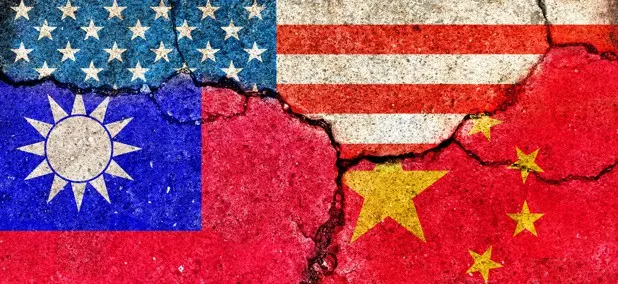
Civil‑Military Coordination Falters in Simulated Crisis
Washington’s readiness for a coordinated Chinese cyber‑offensive targeting Taiwan was called into question Tuesday after a high‑level war‑game simulation revealed serious shortcomings in both military and civilian planning. The exercise, organized by the Foundation for Defense of Democracies, highlighted how fragmented response mechanisms could delay crucial aid to the island under attack.
Breaking news
 Ronna McDaniel Weighs In on GOP's Path Forward
 Market Sentiment Shifts as S&P 500 Snaps Three-Day Losing Streak
 Voters Demand Stronger Congressional Oversight of Presidential Power
 Pelosi Looks Back, Sees Democratic Triumph Ahead
The simulation, conducted over several days in a secure facility near Washington, D. C., brought together senior officials from the Pentagon, the Department of Homeland Security, private‑sector cyber firms, and Taiwanese defense representatives. Participants were tasked with defending Taiwan’s critical infrastructure—energy grids, financial systems, and communications networks—against a sustained barrage of hacking, ransomware, and supply‑chain disruptions orchestrated by a mock Chinese adversary. Observers said the drill exposed „dangerous blind spots” in the United States’ ability to coordinate rapid, cross‑agency cyber‑responses, especially when economic coercion accompanies technical attacks.
The war game showed that military cyber units and civilian agencies often operate on separate timelines and with differing priorities. When the simulated Chinese campaign escalated, the Pentagon’s cyber command prepared offensive counter‑measures, while the Department of Commerce struggled to secure trade‑related data flows. This disconnect, analysts warned, could leave Taiwan vulnerable for hours or even days while the United States scrambles to align its response.
„Even in a controlled environment, we saw delays caused by bureaucratic hand‑offs,” said Dr. Lena Ortiz, a senior fellow at the foundation. „In a real‑world scenario, those delays could translate into widespread blackouts, financial chaos, and loss of life on the island.”
Can the United States Quickly Adapt to a Chinese Cyber‑Economic Blitz?
The exercise also highlighted the limited role of private‑sector partners, whose expertise in defending commercial networks is critical but often underutilized in official contingency plans. Several participants called for a standing liaison office that would bridge the gap between government cyber units and the tech companies that manage Taiwan’s most vital digital assets.
Experts argue that the United States must overhaul its approach to hybrid threats that blend cyber sabotage with economic pressure. China’s recent use of „sharp power”—leveraging trade restrictions, investment controls, and diplomatic coercion alongside cyber tools—complicates traditional defense strategies.
„China is no longer just a hacker; it’s a multi‑dimensional adversary that can choke an economy while simultaneously infiltrating networks,” noted Michael Cheng, a former cyber‑policy adviser to the National Security Council. „Our response must be equally layered, integrating sanctions, supply‑chain resilience, and rapid cyber‑remediation.”
The war game’s findings suggest that without a unified command structure and pre‑approved emergency protocols, the United States may struggle to deliver timely assistance to Taiwan. Policymakers are now urged to draft legislation that clarifies authority, streamlines information sharing, and allocates dedicated funding for joint cyber‑defense exercises.
Frequently Asked Questions
If the United States fails to address these gaps, Taiwan could face a prolonged period of isolation during a Chinese offensive, potentially altering the strategic balance in the Indo‑Pacific. Conversely, a swift overhaul of coordination mechanisms could reinforce deterrence, signaling that any attempt to cripple Taiwan’s digital lifelines will be met with a rapid, coordinated response.
What was the main purpose of the war game? The simulation aimed to test how quickly and effectively U. S. military and civilian agencies could protect Taiwan’s critical infrastructure from a coordinated Chinese cyber and economic attack.
Why are civilian agencies important in a cyber‑defense scenario? Civilian bodies control much of the infrastructure—energy, finance, and communications—that military units cannot directly manage, making their involvement essential for a comprehensive defense.
What steps are being recommended to close the identified gaps? Experts suggest creating a permanent joint cyber‑command liaison, establishing clear legal authority for rapid action, and increasing joint exercises with private‑sector partners to improve readiness.