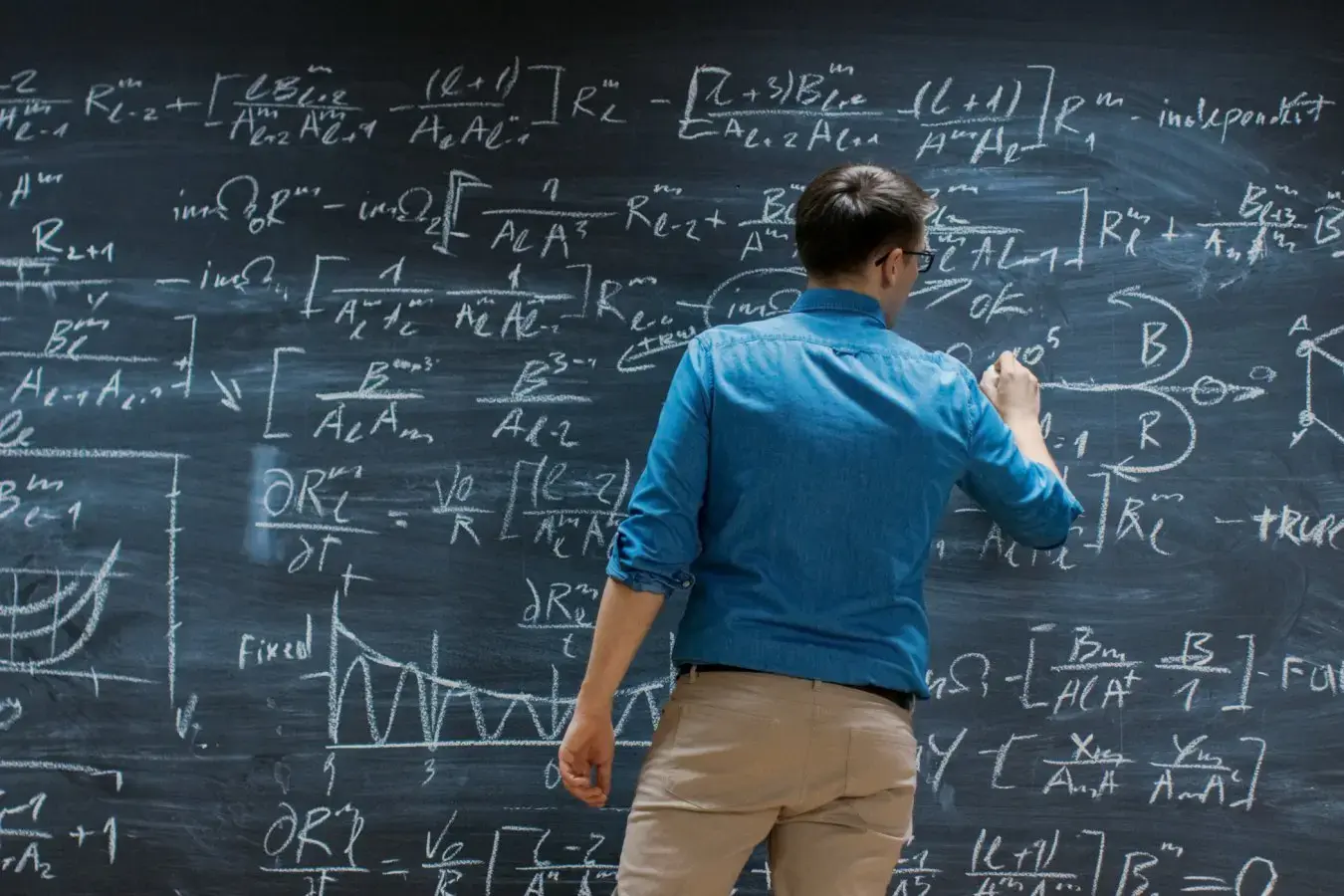
Now, AI systems are being trained to explore patterns in these equations
Mathematicians now possess a powerful new tool capable of cracking problems that have resisted solution for centuries, but figuring out how to use it effectively remains a major challenge. The rise of artificial intelligence in mathematical research has arrived with both promise and uncertainty, as experts grapple with its implications for discovery, proof, and the very nature of mathematical work. For two centuries, the Navier-Stokes equations have described fluid motion with remarkable accuracy, yet a fundamental question about their solutions remains unanswered. Despite advances in computation and theory, mathematicians have not been able to prove whether smooth solutions always exist in three dimensions—a problem so significant it is one of the Clay Mathematics Institute’s Millennium Prize problems.
Breaking news
 Deadly Glacier and Rock Collapse in Nepal Linked to Climate Warming
 US Congress Passes Sweeping Sanctions Against Russia
 Speaker Johnson Ends House Session Early to Halt Impeachment Effort
 The High-Stakes Fight for Senate Majority Control
Now, AI systems are being trained to explore patterns in these equations, offering new ways to detect potential singularities or validate conjectures that were previously beyond reach. Can AI Find Patterns Humans Miss? Researchers are using machine learning to analyze vast datasets of numerical simulations, searching for hidden structures in turbulent flow that might indicate where the equations break down. Unlike traditional methods that rely on human intuition and symbolic manipulation, AI can detect subtle correlations across millions of data points, potentially guiding mathematicians toward promising avenues of inquiry. Some teams have already reported success in using neural networks to predict blow-up behavior in simplified models, suggesting the approach could scale to more complex systems. What Happens When the Machine Outpaces Understanding? A growing concern among scholars is that AI might produce results that are correct but not interpretable—offering answers without insight.
If a neural network identifies a potential counterexample to the Navier-Stokes
If a neural network identifies a potential counterexample to the Navier-Stokes regularity conjecture, verifying it could require steps that humans cannot easily follow or validate. This raises philosophical questions about what constitutes a proof in the age of AI: must understanding accompany truth, or can we accept results we cannot fully comprehend? The integration of AI into mathematics is not replacing mathematicians but reshaping their role, shifting focus from calculation to interpretation and hypothesis generation. As these tools become more sophisticated, the field may need new standards for validation, collaboration, and education. Whether AI ultimately leads to a breakthrough in one of math’s greatest unsolved problems—or simply accelerates the pace of exploration—it is clear that the relationship between human ## Frequently Asked Questions How is AI being used to study the Navier-Stokes equations?
AI analyzes large sets of numerical simulation data to detect patterns that might signal where solutions become unstable or singular, helping mathematicians identify areas worth deeper theoretical investigation. Can AI prove mathematical theorems on its own? Currently, AI assists in conjecture generation and pattern recognition but does not produce independently verifiable proofs; human oversight remains essential for validation and logical rigor. What are the risks of relying on AI in mathematical research? The main risks include obtaining results that are correct but not interpretable, potentially undermining the traditional goal of mathematics to achieve deep understanding, not just accurate answers.