Regional Tensions Fuel Nuclear Interest
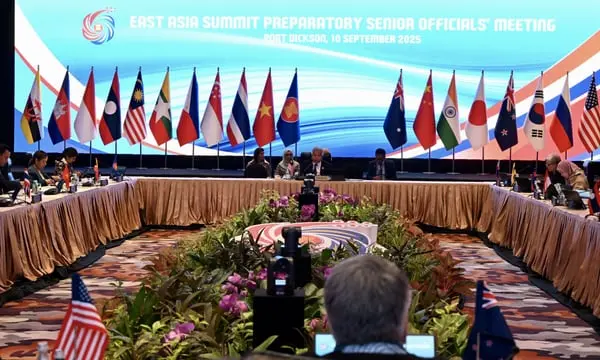
The East Asia Summit convened in Jakarta on August 4, 2026 amid growing talk among regional states about pursuing nuclear weapons. Delegates from ten member countries gathered to discuss security, trade, and now an increasingly urgent nuclear question. The summit’s agenda reflects heightened concerns over proliferation in a volatile neighborhood.
Breaking news
 OpenAI Settles Discrimination Claim for $3.2 Million
 Pharma Executive Eyed for NIAID Director Role
 Annie Jacobsen and Geoff Bennett Discuss Biological Threats
 Arts Program Targets Loneliness in North Carolina
Experts warn that the diffusion of nuclear technology threatens regional stability and could trigger an arms race. As nations weigh the strategic benefits of a nuclear deterrent, the EAS is uniquely positioned to shape collective norms and establish verification mechanisms. The summit’s leaders must balance sovereign security interests with the broader imperative of preventing nuclear escalation.
Heightened territorial disputes in the South China Sea and persistent rivalry on the Korean peninsula have prompted some states to reassess their defense postures. Analysts note that advances in missile technology and the availability of enrichment equipment lower the barriers to entry for nuclear capability. „The calculus is shifting,” said a senior defense official, „and the EAS cannot afford to be a passive observer.” The summit’s working groups are expected to draft a framework that could include confidence‑building measures, joint monitoring, and a pledge to uphold the Non‑Proliferation Treaty. Such steps would signal a collective resolve to keep nuclear weapons out of the region’s security equation.
Can the East Asia Summit curb nuclear proliferation?
The question of whether the EAS can effectively restrain nuclear ambitions hinges on political will and enforcement capacity. Past initiatives, such as the ASEAN Nuclear‑Safety Initiative, demonstrate that regional cooperation can produce tangible outcomes when member states share common goals. However, divergent threat perceptions and domestic pressures may undermine consensus. Critics argue that without a binding treaty or external oversight, the summit’s recommendations risk remaining symbolic. Proponents counter that any coordinated stance, even if non‑binding, raises the diplomatic cost of pursuing nuclear arms and encourages transparency.
If the summit succeeds in forging a robust anti‑proliferation agenda, it could deter aspiring nuclear states and reinforce global non‑proliferation norms. Failure, by contrast, may embolden countries to seek nuclear capabilities, raising the specter of a regional arms race and destabilizing the Indo‑Pacific security architecture. The coming months will reveal whether the EAS can translate rhetoric into actionable safeguards that preserve peace.
Frequently Asked Questions
What is the East Asia Summit’s role in nuclear non‑proliferation? The EAS brings together leaders from ten Asian nations to discuss security issues. It can facilitate dialogue, propose joint monitoring schemes, and encourage adherence to existing treaties, but it lacks enforcement authority.
Which countries are most likely to consider nuclear weapons? Public statements and strategic assessments suggest that nations feeling threatened by regional disputes, such as South Korea and Japan, are evaluating the option, though no official decisions have been announced.
How could the EAS prevent a nuclear arms race? By establishing confidence‑building measures, sharing intelligence on nuclear activities, and committing to collective diplomatic pressure, the summit can raise the political and economic costs of nuclear development.